Fibroblast Growth Factors
FGF-2 & FGF-7
The 2 signaling proteins most directly responsible for telling a resting follicle to grow, and the most mechanism-aligned target in the category.
 By P. NairScience Editor
Of everything applied to the scalp, FGF-2 and FGF-7 are the closest match to the actual biology of the hair cycle: they are the growth signals a dormant follicle has stopped receiving. The mechanistic and animal evidence is strong; the human evidence is real but still limited, which is why the grade is B and not A. We consider them the most important target to watch, and the clearest reason the field is moving beyond signal-extenders like minoxidil.
Grades for hair treatments change. Know when they do. Get an alert when a grade moves, plus each new review. About 2 emails a month. No products, no sponsors.
What they are
Fibroblast growth factors are a family of signaling proteins the body uses to coordinate tissue growth and repair. Two members matter most for hair. FGF-2 (basic FGF) promotes the elongation of the follicle and the proliferation of the cells that build the hair shaft. FGF-7 (keratinocyte growth factor, KGF) is produced by the dermal papilla and drives the keratinocytes of the hair matrix, the engine room of a growing hair[1]Lin WH, et al. (2015) — Fibroblast growth factors in the regulation of the hair follicle cycle. Exp Dermatol..
They are not exotic additives. They are the follicle's own vocabulary, the same molecules the tissue uses to talk to itself. Pattern hair loss is, in part, a story of this conversation going quiet.
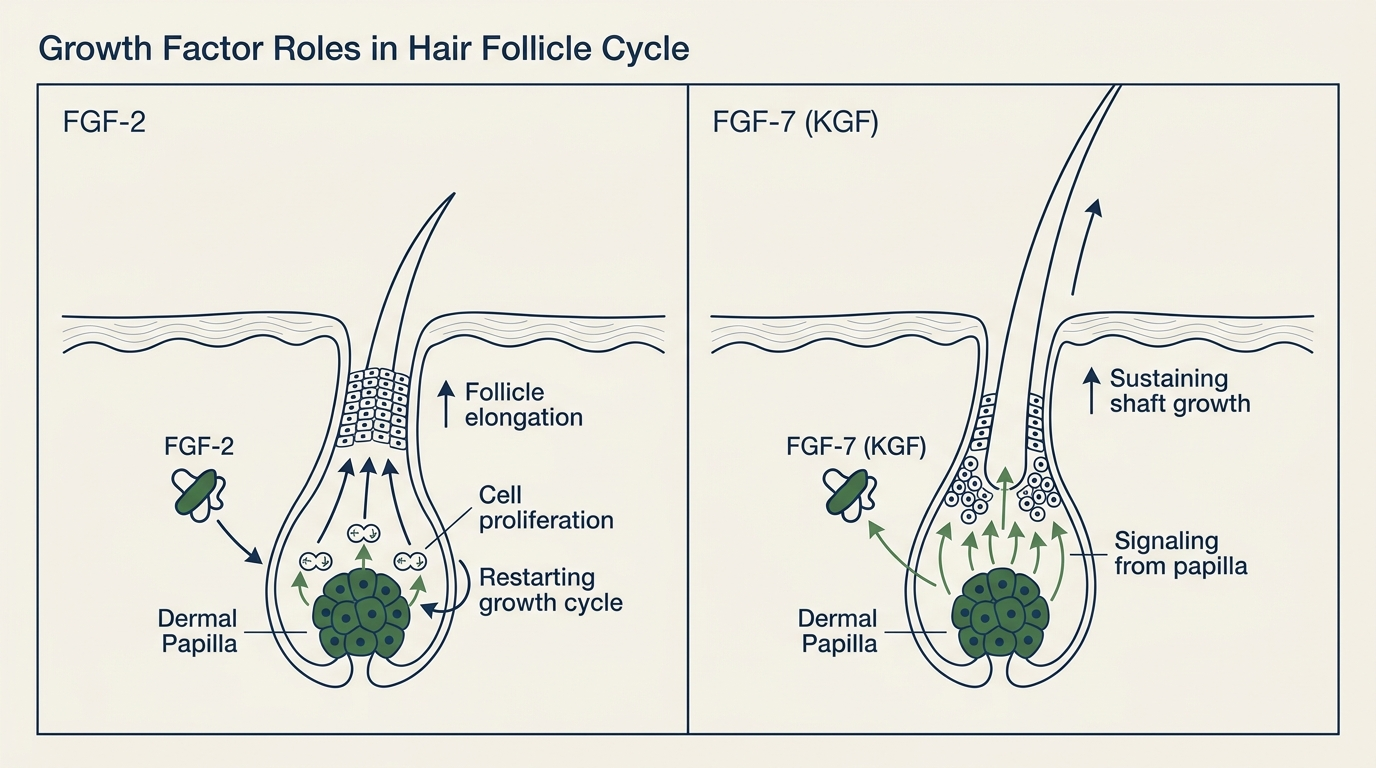
Drives follicle elongation and dermal-papilla cell proliferation. In models, it accelerates the telogen-to-anagen transition, restarting the cycle.
Signals from papilla to matrix, sustaining the proliferation that lengthens and thickens the shaft during active growth.
Mechanism
The hair cycle is governed by the balance between growth-promoting and growth-inhibiting signals at the base of the follicle. FGF-2 and FGF-7 sit firmly on the growth-promoting side. When they bind their receptors on papilla and matrix cells, they push a resting follicle into anagen and keep the growth phase running[2]Rosenquist TA, Martin GR (1996) — FGF signalling in the hair growth cycle. Dev Dyn.. Knock the signal out in animal models and follicles stall in rest; restore it and they re-enter growth.
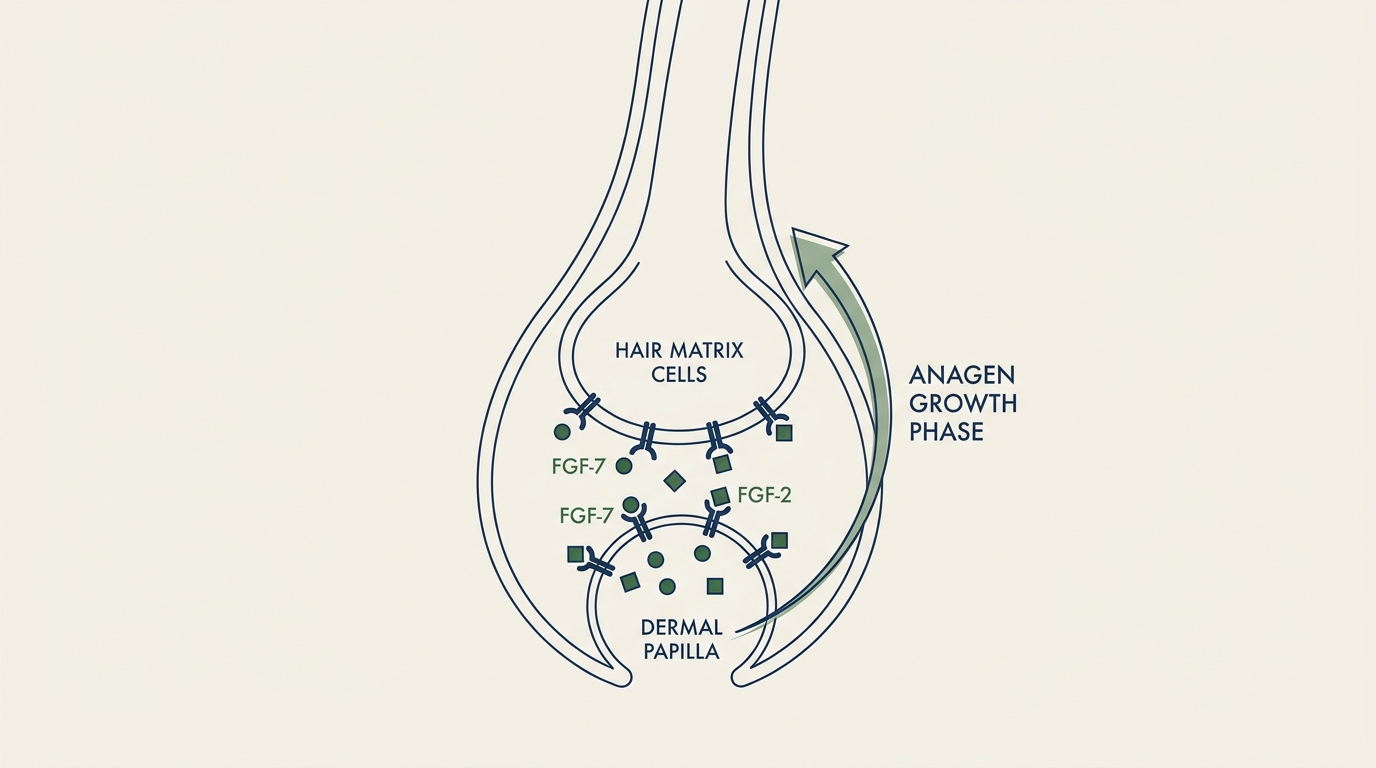
This is why growth factors are mechanistically distinct from everything else in the category. Minoxidil extends a signal already present. DHT inhibitors remove a brake. FGF-2 and FGF-7 are the growth signal itself, the only approach that addresses the missing instruction rather than working around it.
What the evidence shows
We separate what is well established from what is still emerging, the honest picture behind the Grade B.
- FGF-2/FGF-7 initiate and sustain anagen in vivo
- Consistent regrowth signals in animal models
- Receptor pathways in human follicles are mapped
- Robust cell-culture proliferation data
- Large, long human RCTs are limited
- Optimal dose and frequency not standardized
- Head-to-head vs. minoxidil not yet run
- Delivery method varies between studies
Why potency was never the problem, delivery is
The single biggest reason growth factors underperformed in early attempts has nothing to do with the molecules and everything to do with getting them in. FGF-2 and FGF-7 are large, fragile proteins. The stratum corneum is built to exclude exactly such molecules, and an unprotected protein degrades before it reaches the papilla where it is read[4]Prausnitz MR, Langer R (2008) — Transdermal drug delivery. Nat Biotechnol..
This is the crux of the Grade B: the signal is correct, but it only counts if it arrives. Lipid carriers such as oleosomes, whose shell resembles skin's own lipids, are the delivery route most likely to close that gap, and the variable most likely to separate a study that works from one that doesn't[5]Barani H, et al. (2018) — Lipid-based nanocarriers for dermal delivery of biomacromolecules. Int J Pharm..
How they compare to conventional options
Not a ranking, a map of where each acts on the cycle.
Read honestly: minoxidil and DHT control carry more human data (Grade A) and remain the evidenced baseline. Growth factors carry a lower grade on human evidence but are the only option that supplies the missing growth signal directly, which is why we treat them as complementary to, not a replacement for, the established agents, and as the most important frontier to track.
Safety & what we'd want to see next
Topically applied growth factors have a reassuring early safety profile, they are versions of molecules the body already produces, acting locally. As always, systemic exposure from a well-formulated topical is expected to be minimal, and the main open questions are efficacy and consistency, not obvious safety signals.
To move this from B to A, the field needs larger, longer, independently run human trials with standardized delivery and hair-count endpoints. We will upgrade the grade the moment that evidence arrives, and we will tell you exactly what changed.