The signal your follicle stopped hearing
In pattern hair loss the follicle is rarely destroyed. It goes quiet, starved of the growth-factor signal that starts each new cycle. We trace that signal through the literature, and ask the question the shampoo aisle avoids.
 By P. NairScience Editor
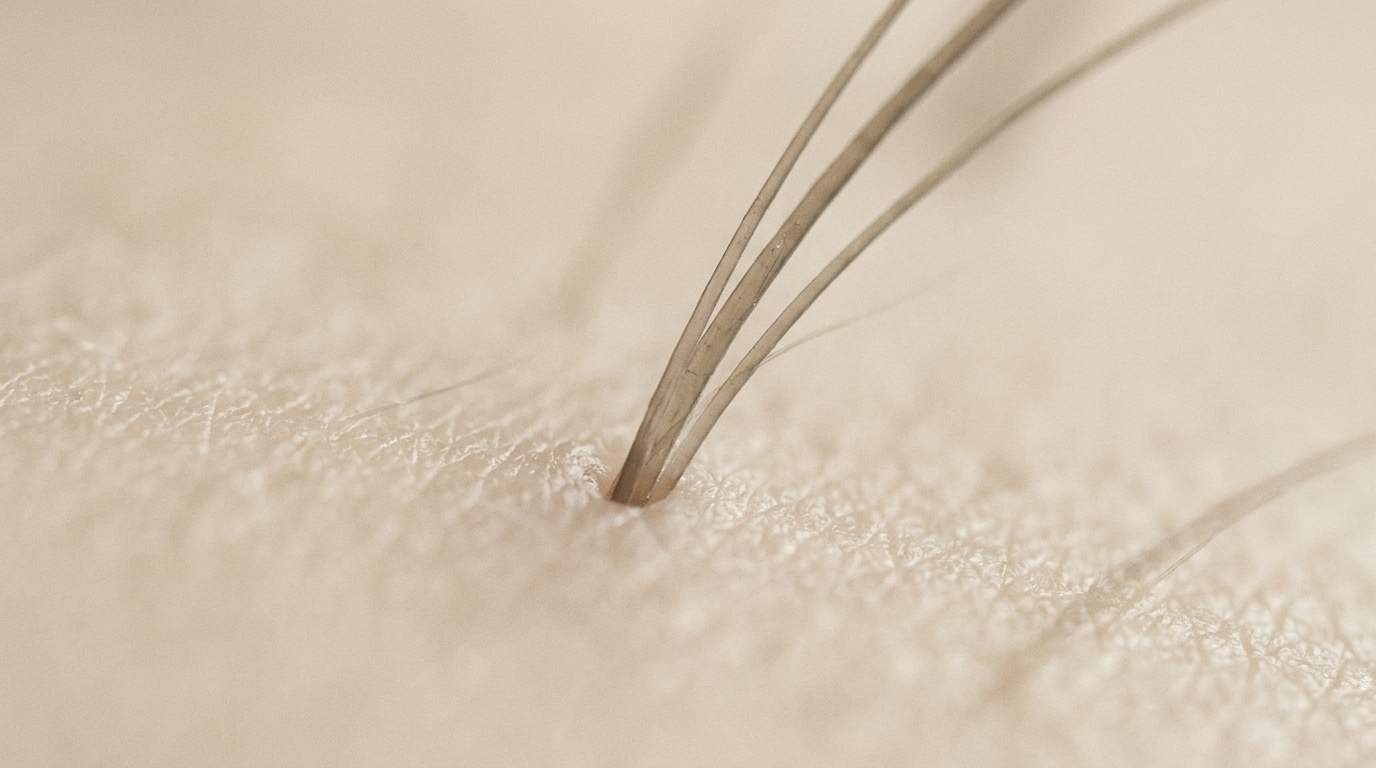
A follicle on a broken clock, not a dead one
Every hair follicle cycles between growth, regression, and rest. What decides how long each phase lasts is chemical signaling between the follicle's stem cells and the dermal papilla beneath it. Among the most important of those signals are fibroblast growth factors — FGF-2 and FGF-7 in particular, which help push a resting follicle back into active growth[1]Lin WH, et al. (2015) — Fibroblast growth factors in the regulation of the hair follicle cycle. Exp Dermatol..
In androgenic hair loss, the follicle miniaturizes over successive cycles. But the stem-cell reservoir survives long into that process. The follicle is not gone, it is under-instructed. Restore the instruction and, at least in animal models, dormant follicles re-enter growth[2]Rosenquist TA, Martin GR (1996) — Fibroblast growth factor signalling in the hair growth cycle. Dev Dyn..
This reframes the whole problem. The question is not "how do I kill the hormone?" but "how do I get the growth signal back to a follicle that has stopped hearing it?"
Two categories, one shared blind spot
Almost everything sold for hair loss falls into 2 buckets. Each does something real. Neither addresses the signal directly.
Prolongs the growth phase already underway. Real, replicated, but maintenance-only, and it does nothing to restart a follicle that has already gone quiet.
Slows the driver of miniaturization. Useful upstream, but removing a brake is not the same as pressing the accelerator. The dormant follicle still waits for its signal.
And there is a quieter problem underneath both. Most topicals never reach the dermal papilla at all. The outermost skin layer, the stratum corneum, is built to keep large molecules out. Growth factors are large molecules. Applied naively, they sit on the surface and degrade[3]Prausnitz MR, Langer R (2008) — Transdermal drug delivery. Nat Biotechnol. — On the barrier function of the stratum corneum to macromolecules..
Which is why, for growth factors, potency was never the bottleneck. Delivery was.
Oleosomes: a delivery vehicle borrowed from seeds
Plant seeds store oil in tiny, membrane-wrapped spheres called oleosomes. Their outer shell is chemically similar to the lipids of human skin, which lets them ferry a delicate cargo across the stratum corneum instead of stalling on top of it[5]Nikiforidis CV (2019) — Structure and functions of oleosomes. Adv Colloid Interface Sci.. For a large, fragile molecule like a growth factor, that shell is also a shield against degradation on the way down.
So the mechanism-matched approach is not exotic. It is simply the pairing the biology has been asking for: reintroduce the specific signals a quiet follicle is missing — FGF-2 and FGF-7, inside a carrier that can actually deliver them to the papilla where the signal is read.
The evidence here is Grade B, not A: the mechanism and animal data are strong, human trials are still limited. We are not telling you it is settled. We are telling you where the mechanism points.

None of this makes minoxidil obsolete or hormone control irrelevant. They address different points on the same cycle. But if the follicle is dormant rather than dead, the missing piece has always been the signal, and the reason the signal failed to work in the past was that it never arrived.
That is the part of the problem the industry hasn't wanted to measure. We will keep measuring it.
Read the full FGF-2 & FGF-7 monograph →This review discusses an ingredient approach as an example of the mechanism described. The Trichology Review is independent and reader-supported; we take no advertising from ingredient or product manufacturers. Grades follow our published methodology.
- Lin WH, et al. Fibroblast growth factors in the hair follicle cycle. Exp Dermatol. 2015.
- Rosenquist TA, Martin GR. FGF signalling in the hair growth cycle. Dev Dyn. 1996.
- Prausnitz MR, Langer R. Transdermal drug delivery. Nat Biotechnol. 2008.
- Barani H, et al. Lipid-based nanocarriers for dermal delivery. Int J Pharm. 2018.
- Nikiforidis CV. Structure and functions of oleosomes. Adv Colloid Interface Sci. 2019.