How hair actually grows
Before any ingredient makes sense, the biology has to. A follicle is a small organ on a repeating clock, governed by chemical signals. Understand the clock and the signals, and every intervention in the field falls into place, including why some work, some don't, and where the open questions are.

Every follicle runs on a three-phase clock
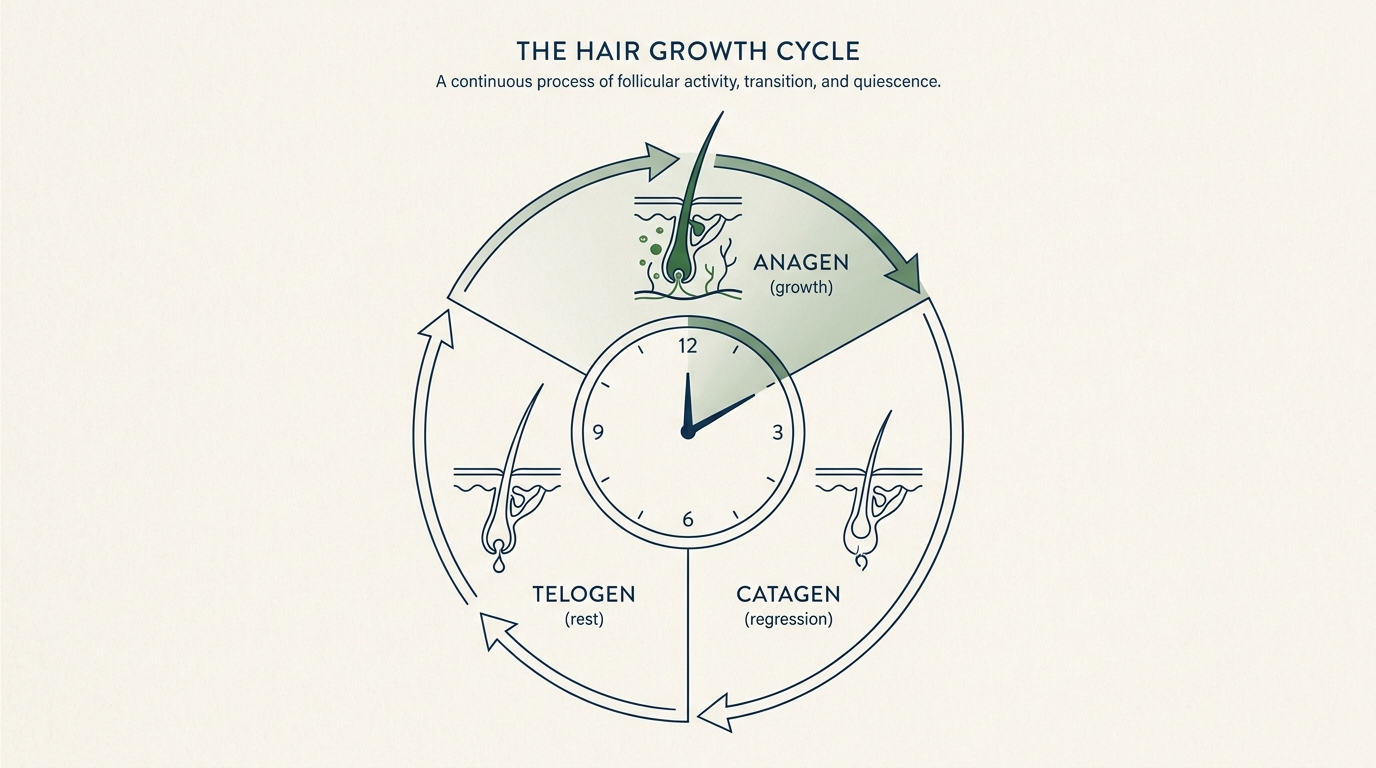
Hair is not continuously produced. Each follicle cycles through anagen (active growth, 2–7 years), a brief catagen (regression, ~2–3 weeks), and telogen (rest, ~3 months), after which the old hair sheds and a new anagen begins. At any moment about 85–90% of scalp follicles are in anagen. How much hair you keep is, at root, a question of how long anagen lasts and how reliably the cycle restarts.
The dermal papilla is the control room
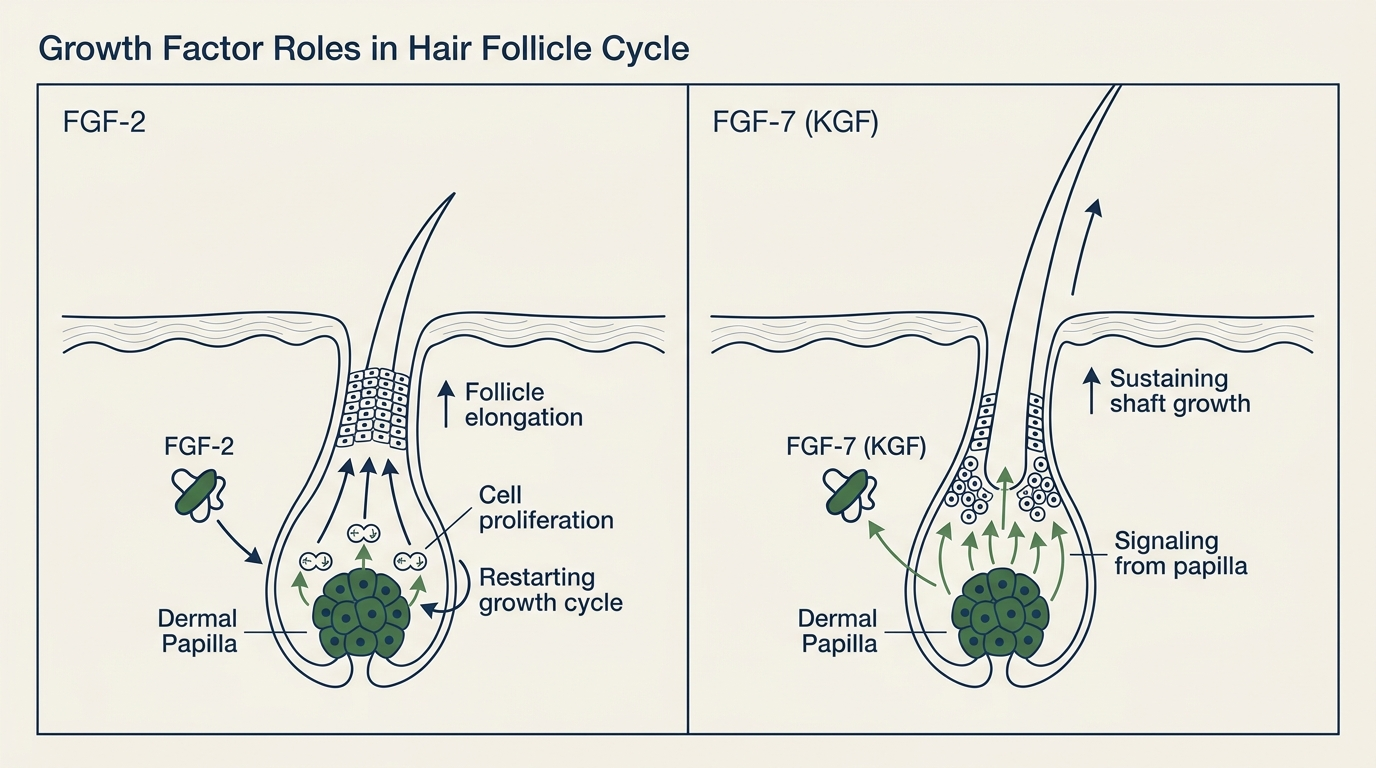
At the base of each follicle sits the dermal papilla, a cluster of specialized cells that instructs the surrounding matrix cells to divide and build the hair shaft. It is the papilla, not the visible hair, that decides the follicle's fate. Signals received here determine whether the follicle grows a thick terminal hair, a wispy vellus one, or nothing at all.
Miniaturization: the follicle shrinks, it doesn't die
In androgenic hair loss, sensitive follicles react to DHT (a derivative of testosterone) by shortening anagen with each cycle. Over years, a robust terminal follicle produces progressively finer, shorter hairs, miniaturization. The critical, hopeful detail: for a long time the follicle and its stem-cell reservoir persist. It is under-instructed, not destroyed, which is why intervention earlier in the process reliably works better than intervention late.
2 forces decide the outcome: the brake (DHT shortening the cycle) and the accelerator (growth signals restarting it). Most of the field manipulates one or the other.
Growth factors are the accelerator
The papilla and its surroundings communicate through signaling proteins. Among the most important for driving anagen are the fibroblast growth factors — FGF-2 and FGF-7 — which push resting follicles back into growth and sustain the matrix once it is running. Understanding this class is the single most useful thing a reader can do, because it is where the mechanism of hair growth is most directly addressable.
Why the barrier matters
The skin's outer layer excludes large molecules. A signal that can't reach the papilla can't act, so how an ingredient is delivered often matters as much as what it is. More on delivery →
The same organ, different pattern
Female-pattern thinning shows diffuse density loss rather than a receding line, and its hormonal picture is less clear-cut, which is why male trial data does not simply transfer.